The rub. If I am not responsible for the whole world, for every component of it, from its minutest to its monumental elements, then for what am I responsible? Anything less than limitless responsibility turns responsibility on its head and into a deformed image of itself. We are responsible for all, everyone, anything and everything, always, before we are responsible for anything. We cannot have one without the other, just as we cannot have a room in the house without having the house, or a continent or a span of the sea without having the earth.
The issue of skepticism
The issue of skepticism. Skepticism is an issue, from a nuisance to a scourge, only when we turn it into dogma or become, as it were, convinced by it. Then and only then does it show our neurosis in being unable or unfit to reside in the middle-ground of things; otherwise it is a healthy stance and expressive of health, not being content with the extremes of things or their obvious faces, but being willing to approach the shades and shadows of the painted, lighted world.
Sure, a healthy skeptic may be uncertain even of what seems most guaranteed for him, but for him this lack of knowledge is more of a background than his sole atmosphere, a dim voice calling to him from behind the din of beliefs and insights with the reminder that the journey is not over yet and cannot reach its end as easily as in the rest of certainty. So, does this mean that even in the face of death, that most assured thing to which we cannot but come, in the end, at some time or at any time, we may have anything like doubt? Death comes, yes–an immortal skeptic seems as unlikely, as outlandish and as absurd as a squared circle: of that we can be certain, and we may laugh at the skeptic for his antics. But he has the last laugh when he realizes, as we all must realize, in the face of the death all around us, that inescapable visitation, that he just cannot say he knows what is coming to him, or what is coming to any of us for that matter. Death still has its background voice, its shades of colors on the backdrop of the corpse with its blatant presence.
What is it, then? How are we to live, what should be our practice, when we are attuned to the call of skepsis and at all times? What would be the difference in this constant attunement from the more global and explicit skepticism that is our possible bane and heady trouble? The answer can only be, as it turns out in so many good things: it is more playful, this beautiful skepticism, and sees in our lack of a black and white world nothing to scorn, sees in the grays of life things to be cherished, really, like gray clouds against the blue-white of the sky, those storm clouds which are surely coming but, when they finally reach us and pour down with second- and rear-thoughts, will wash away the structures built by our certitude, even our noblest. It plays in the rain and is the rain itself.

Where are we going?
A Metamorphosis
Nothing Left of You
It’s simple: remove yourself from the world, then the world will not miss you, it will not even think of you.
The trouble is removing yourself from the world, because suicide is one sure way of not doing so.
Suicide still stinks of the world; in fact, it is the utmost expression of the world, and this could be no different.
What, then, does it mean to remove oneself from the world and to properly retire? That’s our question now.
So many of our spiritual forefathers and foremothers went on and on about renunciation--that hellish joke!
One spiritual forefather saw clearly enough through renunciation to see: renunciation is a grab for power!
Power and nothing but power, and the world is power throughout. So: how to remove yourself from power?
Become weak, so weak, in fact, that others ridicule you or feel embarrassed by your presence, weak like a twig.
Broken and weak and breakable through and through; then you may finally say to yourself that you have succeeded.
You will then have succeeded in becoming a No One and the only man who doesn’t give a damn anymore about anything.
No matter if the whole world, all the babies and mothers and brothers and sisters and fathers and friends--
--no matter if everybody calls out to you with pathetic cries for you to help them, you may look on indifferently.
The skies will still continue to change color and will alter in terms of density, waters will still fall or not fall from those skies.
But in drought you will not ask for water, nor will you ask that the waters cease when the flooding comes in.
When there is unbeatable flooding all across the nation and across every land, you will not even grab a vessel.
You will not even learn or try to swim, nor will you complain when the water starts to stop up your throat.
You will let the salt dryly coat your throat, coat it so much in fact that you will be unable to utter another word.
Words when you lived before in a world of words, words and always words: they will seem to you childish pranks.
Though there is nothing and no one to thank when you look up or when you look down, when you peer inside or outside.
Though there is no one to thank, your face will be one of gratitude, one forced to gratitude, though it says nothing.
Though your face, like every other part of you, now floating in your lack of care, is completely, utterly silent.
One friend from among the old friends you used to have, who would gather around you with love, will say to you:
Why not just be done with it and die, like a command; he will not realize that he is speaking to one as good as dead.
Better than dead, he is speaking to a man who left behind the world in order to face alone what is not world.
And what is not world? It is like the absolute, the uncontainable container of all the precious and trivial and harmful things.
So we are back to what one of our more perceptive men of renunciation once said to us: take an absolute stance.
Take an absolute stance in the face of the absolute, absolve yourself of all the relative nonsense of tragedy and comedy.
But there is nothing besides tragedy and comedy, the world will shout, all the citizens of the world will shout out in unison.
But they are wrong: there IS something besides tragedy and farce, and you will prove it, you uncaring landless man.
You will prove it to them in no time at all, but the proof will look like the proofs a madman submits to a test.
As though in a fit or in a dream you once came to the notion of Nothing Really Mattering, you will not even say your proof.
So the proved might as well be the unproved, it might as well stay packed up somewhere in the dark room of you.
There will be one man, however, who knew you a long time, who will not be so easily satisfied with you posture.
Nor will he be so easily contented with dissatisfaction, he will call you an imposter and poseur to your face.
The man’s criticism, verging on condemnation, of you will not work: you will not even shake your head to what he says.
He will at first damn you and curse you, then he will laugh at you; finally, and worst of all, he will ignore you.
As though you never were, he will ignore even the fundament of you, let alone all your unmoving surfaces.
He will gaze past, like an adventurer, the still lake of you and consider what lies there: mountains and villages.
Villages and mountains and human and nonhuman narratives, skies and horizons of all sorts, empty of you.
He will have felt that ignorance, ignorance of you, dear friend, has taught him an irreplaceable lesson, a mighty lesson.
He would turn to you happy with your courage to do what no other could or would dare, but he cannot remember you.
He will not recall the slightest thing about you: your name, your tired expressionless face, your uncaring dress.
Nothing, he will recall no one, just as you must have wished if wishes were still any part of your repertoire.
But they are not: along with everything else, even your conatus which is all of you, it was rid of long before the wish to die.
The wish to die will seem like nothing to you then, that wish that came to you so many unspeakable times before.
Before you knew better, that is. Friends and foes and family and sisters and mothers and fathers and brothers and babies--
--everyone surely would be worried about you, or where you have gone. That is, if they knew a thing about you.
Not even two things or three meager characteristics of you, but one slender trait, say the color of your eyes.
Or the brown color of you, any measly thing. But they do not, and they will not ever again. You have disappeared.
You will have disappeared across and beyond forgetfulness. There will be precisely nothing left of you.
Spanning the gulf, or trying to, come what may
Spanning the gulf, or trying to, come what may. The spark was in me but not in him. That’s how I found out about the subjectivity of love, our being locked away in little capsules, as it were, closed off from one another, in the pain and agony, the agonizing of this distance. We shared something, yes, but it wasn’t love. Love is what you say when the gulf is widest, so wide, in fact, that you lose yourself staring out at your beloved, who is standing out there beyond the horizon, beyond any horizon, really even beyond the horizon, the terminus, of your desires. So far beyond the horizon, in fact, that the lines begin to blur between what you love and what you merely pass by and ignore, or what you are averse to, between love and its opposite. So at the height of love, or at its depth, no matter which, when you are compelled to look so far, so deep, so beyond where you are merely satisfied, reciprocity isn’t all that important, it isn’t fundamental or what bids your eyes seek on. We love despite this hopelessness embedded in our love, because of it, since love would be nothing if it is not stronger than hope, more enduring than any hope.
Calling Azur
We used to go out into the sunshine
And let it soak into our cheeks
With the freedom we feel when we get sunshine
On our work-torn faces.
Or the freedom we felt, for now
The sun is a menace, its light streaks
Across the scarred earth
A rusted dagger, its rays the color of rust.
The rust of our faces, too
We had seen too much and there were
No traces of trust left on us
Our faces like a wood turned to metal.
Or vice versa, we were steel turned mahogany
Enriched in hardening by Helios' smelting
More agony the more he pounded
At the brittle layers of us all.
On what is social in poetry
On what is social in poetry. –Nothing. If by this it is meant that poetry should utter and participate in the latest movements, the most recent crazes for revolution, institutional reform or commentary, placing itself on one side or the other, or even at a distance but with an eye for such contests, of some social ideology or social dream. For does it ever mean to? Despite our sociality, does language at its height–care for such things? Sure, it might have something to say of the latest ills faced by men and women attempting to live together, attempting to have anything of a future; poetry may say something about anything. But this is circumstantial, as expressive of its final limit or stopping point as its speaking of grasses and mountains or moons and stars. Poetry speaks–well, because it has something to say, not because it is of use in this fashion or other, because it might serve someone’s vision or give utterances of the dreams of some utopia. That it might be so used–again, anything can be so used, as information of all kinds, insight of all kinds, are used for helping or hurting, for building a cohesive and thought-through image of things or to drift helplessly in the chaos of so many possibilities–that it might be geared towards reform, revolution, social commentary, belongs to the reformer, the revolutionary, the commentator, not to the poet. Although he might feel this godlike and grandiose responsibility in the face of history, as harbingers of new eras, new tongues, inventions at the bedrock for what’s to come for the species, examples or lights on a wasted earth, the poet, as poet, sits or stands, walks along through any world, even our world, when things seem so near catastrophe that writing seems a worthless venture, and continues singing. All rather useless songs! All rather irresponsible songs!
Inventing ourselves
Inventing ourselves. We invent ourselves with what we have at our disposal, and sometimes this isn’t much, only meager things lying around. We chance upon them and we’re forced to do something with them, even if it’s not exactly what we had planned, what the brain and the heart and the sinews of our body had envisioned. It’s not so much compatibilism as it has been traditionally understood, nor is it simply a matter of dependency versus independency; instead it’s more of a collection of materials, we could call them perspectival shards, all meshed and muddled together, and from the pile of them, selected and padded for some outlook on them and to contribute to their manageability, some amount of them, some portion of them, stands out as our lives, what we want to say is our lives. To be thrown into life the way we are is not to be abandoned to a foreign life, or set against it as a species unique in its distance from other living and nonliving things, not when everything is thrown together. There is no dread in such a world, unless to be confused is to dread, unless to be at a loss for direction and horizon is to dread. But they are not, at least not necessarily: there is such a thing as a joyous confusion and disorientation. We invent ourselves, we say, but the matter is not as simple as all that. We must discern, before we take another step, what it was that came together to invent us, to invent–our inventiveness. We must discover–the only thing we discover, really–how necessary we are, along with how contingent, before we give our hands to creating anything, let alone ourselves, that standpoint from which we shall meet the world, or what shows itself of the world. It would make no sense otherwise, much as it would make no sense if a painter set out to paint, without acknowledging color, the colors of the palette in his hand no less than the color of his hand itself.
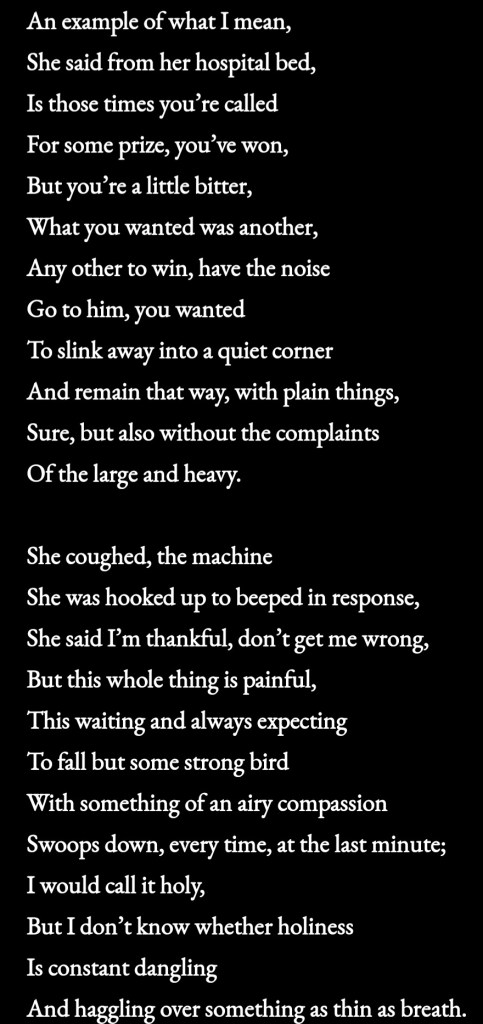
An Example
Not all, but part
Not all, but part. We do not make all of reality. Granted. But we do make a part of it as we make up a part of it, as we must. The worst parts, the spoiled elements of a dish that is otherwise sound and otherwise good, wholly sound and wholly good. How are we given to realize this, the stain we leave on the whole of things? By our desires, by how fundamental our desires are to us, by how our desires are always for something else than what the world has to offer us, in reality, in all its splendorous reality. By the fact, the intractable fact, that our wishes are so often dashed, fundamentally dashed if it weren’t for our being able to accommodate ourselves to less than we set out for. Once one of these wishes, these desires, these ideals is revealed to be a sham, they all are, they all fall into the same vortex with the first example. We see, at once, a terrifying At Once, how they are all figments of our rather paltry, pathetic, impatient and weak imagination. It would be impossible to turn back to the meal life offers at its banquet, to become connoisseurs of living flesh and living tastes, if it weren’t for life’s being so indelicately satisfying; we would sooner lose our taste and all our appetite than eat again! When everything goes our way, how difficult it is to be hungry! So we must thank life for its throwing us a bone–at a curve! We must thank it despite our lack of constitution to digest what it throws our way!
Care-less
Maybe this earth does not care about us. In that case, are we wrong–to care about the earth? Maybe it is a superabundance of spirit that gives us care for the earth, this home of ours whose rooms we can never exhaust. We can mine them and drill them and siphon them dry, we can damage them, but we cannot exhaust them. It is we who are exhausted when we call the world exhausted by us and by all of our impropriety. We and all the livings with whom we commune, whose eyes we see are exhausted similar to ours, we have had enough, the pressure is too much, resources are dwindling, our work is meaningless, even our art is becoming artless. The earth meanwhile goes on its way and nods on its axis like one swaying to some secret and internal tune. Falling in love with this great–great but small, small but vast–untender body from our state of exhaustion can be a heroic enterprise, with a background of hope that such love will vivify the earth, and that the earth’s vivification will equal our own. Exhausted–by our abundance, by our tireless love of the earth or of something about the earth. It is a grace and an astonishment to find beings like us anywhere at all, on the earth or away from the earth. Despite being exhausted, despite the implications of our exhaustion being so dangerous, to love how we have loved in the midst of carelessness is one of the primal and everlasting wonders.
But perhaps we can learn something from the earth’s carelessness and endurance in carelessness. Perhaps we care too much, and care too much about our own care, when we care about the earth. It might just be that our caring the way we do about the earth is the brewing condition for our carelessness, if it is not itself the height of carelessness or its efficient cause. Careful beings that we are, we might go looking for care and things to care for all too much. Even if the earth cared, we might care for it too much. For let’s imagine that it cares. Then it cares in its own way, as each thing cares: it splits here and erupts there; it drains here and floods there; it rises up to the sky and stars here, with arms of stone, and there lowers itself to the core of itself as far as it physically can. Then this care we imagine shows as carelessness, while our carelessness shows–ever eager to show–itself as care. Then we have the whole thing wrong, or we at least imagine that we might have it all wrong, and we have to start over again and from the bottom in our considerations of what it means to care for anything, let alone the earth, let alone this piece of dust among all the other dust swirling around everywhere and making fire as though indifferently from one end to the other of all things. It might be a tremendous deficiency of our spirit when we run away from this indifferent fire and rush headlong into our desire and our cares.
Dawn in Hades
No known cause for the return of faith
No visions or sudden insight
The gods dead like before, God dead like before
The steam still rising and the bodies
Still dancing through the steam in oblivion.
The voices echoing all around still
Have no chance of getting through to me
They are all speaking such plain idiocy.
But the shapes of their lips are mesmerizing
And of the fate they draw.
Good for a laugh
Good for a laugh. Our beginnings probably heard a lot of babble, and the earth and all the other beings on the earth then probably looked at us askew, like elders upon the young, asking themselves and one another what would become of these weak, fretful, and grunting lives.
We took our time, a painfully long time of not knowing at all what we were saying to one another, what we were trying to say, of attempting to practice our tongues and refine our speech, until some neat but powerful words came from our mouths, words like I, and Is or Am, or What or Who or Why or Where or When or How…then we thought most of ourselves, despite the earth and the other denizens of the earth still thinking the same of us, still laughing at us in our procrastinating maturity.
Neat, powerful, sure, but still laughable words, for the whole world laughed at our utterances then as it still laughs now, laughed at our first words as it shall laugh at our last. Ages and ages of being the butt of the world’s joke, of refusing to come of age more thoroughly, we hold onto our stock phrases like a grace, like our only hope, as onto something that defines us, something without which we are utterly lost.
A sensible effort, holding onto these cries at any cost. For we have nightmares now and again of the alternative, of what we could fall back into: the incommunicable, babbling and nonsensical grumbling. But that laughter, it erupts all around us, overwhelming and infectious. Our science and our organization of the world into bits and bytes and measurable chunks and pieces notwithstanding, the laughter of the world at us is infectious, so infectious that, in our stronger times–in our weaker ones too, though it comes differently then, this laughter–we laugh along with the world, at ourselves, we grunt with the grunts of laughter at all our grunting, both our old grunting and our new, more refined grunting. That evolution ever gave birth to speech seems laughable, from its beginning to its foreseeable end–but good for a laugh, good for a hearty, truthful laugh as emits from us now, the lines, planes and bodies of the world, the world itself, shaken by our laughter, convulsing, laughing along with us, as much with us as at us.

As it begins, so it ends
As it begins, so it ends. That’s how it all began: I rubbed his head as he lay on my lap, and the plane took off into the sky. I cried as I saw the wheels lift off from the tarmac, saying to myself How far away, and feeling that I might not see those I left behind, not ever or at least not for a long time. I rubbed his head and got aroused with the blond and brown softness between my fingers, the way I had become aroused the night before, when he held me like a father and we slept together. That’s how it all began and I believe, I know, that’s how it will all end; my downfall will be the same, happen in exactly the same manner, as my upfall. A man will crawl beside me in bed or on a plane, or anywhere for that matter, and whisper things into my ear, promises he could never keep, and I will believe him, and, without ever making love with him and without the hope of ever doing so, I will do anything, risk anything, become anything, sick or healthy, wise or the damnedest fool, if only he is at my side.
It hasn’t worked, my loyalty: he is long gone, injured, perhaps dead by now, and disappeared. I haven’t become any better for all my loyalty and all my fantasizing of having a partner for life. But, oh, I’ve changed, as a mountain changes, though not through slow erosion, but through an earthquake, or an avalanche. Entire pieces and peaks and valleys of me have been split asunder, giant-sized chunks have fallen off, into the sea, have put all the lands of the earth on alarm for flooding.
Jots
People will put themselves through all sorts of hells just to make sure that we all come along with them. There is a certain relish in increasing your own suffering when you know that you will not be suffering alone.
*
Severe coincidences sometimes seem like the only hope in a godless world to still see the divine everywhere.
*
One wondrous thing about wonder is that it does not stay, and we go back to plainness all around, so that what was once wondrous is now ordinary and mute.
*
There is ordinary love and there is extraordinary love. Oftentimes extraordinary love seems lesser than ordinary love, and arrives dressed in unforgiving clothes, or comes naked but–unattractive.
*
Human beings do not have any purpose on this earth, that much can be agreed upon. In order for us all to have a purpose, we would have to agree on it, we would have to–have the purpose. Which, again clearly enough, we do not. Lucky for us, love needs no purpose in order to be love, and all of us being wayward siblings on this planet might not serve any purpose, but it is still profound and worthy of deed and glory.
*
I live with a cat who can spend an hour licking plastic bags, most likely because of the sounds of the crinkling plastic as it moves from the darting of his tongue. Every being has its quirks. Adore them for those quirks. Just watch out that they do not suffocate from them, and do not be afraid to point out when they might be in danger of doing so.
*
Perhaps the history of religions might have had more use for human beings if the holy people spoke as much about what they thought of and where their hearts were while pissing and shitting as they did of other holy things.
*
I am more modest than Sophocles, and say merely that you will probably never encounter a wonder more wondrous than the human life you encounter next. Any human life. You can travel to the ultimate edge of things where darkness and light fuse into one, and it would be no match for the beaming or dull face you find on the next street corner. Probably.
*
Humans lived a long time without paints and pianos and were still creators. The worry that artificial intelligence will steal our very creativity from us is an overblown worry, a shoddy argument born of laziness and hypnotism by cheap tricks.
*
The sponge used to wipe away the entire horizon has a horizon itself, a horizon of grime and filth, and maybe some glistening suds besides.