Achieving Immortality

Are you afraid of anything?

Yes, but it’s not death.  On my tombstone I want the words: he laughed. (Laughs) Never mind: I don’t want a tombstone; they’re a waste of the time of the living as well as the longer time of being dead.

So what is it that frightens you?  You are always skirting the issue of fear!

Oh, my dear friend!  You are always plaguing life with fear!  Fear fear fear everywhere!  They are banes on human existence: fear, laziness–and stupidity!  But I will tell you in any case, since you insist upon it.  It’s something rather stupid itself, but ever since you mentioned last night the possibility that our consciousnesses, at some time in the future, will be locked up in some type of digital encasement.

This frightens you?  What I told you last night about the one chance humanity has to achieve immortality?

Yes, I guess it’s that most of all, achieving immortality, that scares me without relent.  What does it even mean?  Come to think of it, there’s nothing worse under the sun–than the sun never setting!

You’re saying that it’s better to live with the knowledge of death–

–Yes, so that the life may have the ending it’s been hurling itself towards.  It’s not a mistake, that is, we’re not saying the wrong words, when we say of the dead that they are resting. It is a deserved rest, the internment of the human body, at the close of an undeserved–no one deserves it!–few or more moments on the earth.  We are tossed onto the earth’s surface as though in a hurry, away from nothingness, only to make our way towards it again, hurrying our whole life long with the background of our species’ trials and error haunting us: it’s injustice layered on top of injustice; the first thing we should do, crammed up on the crust of the earth the way that we are is–exit!  Exit from existence!

Well, that’s rather bold of you to say.  I mean, yesterday you spoke in a different tune, you told me that you are ready to live this life innumerable times over?  Didn’t you say that to me?

Yes, I did.

Innumerable times over, that’s what you said.  I remember feeling that that was unbearable, such a forced immortality, having to live through life countless times.  Now you tell me you don’t want immortality, you want to exit.  It seems to me all rather contradictory.

I understand why you tell me this now, but I meant what I told you last night.  The eternal recurrence, as I understand it, is a different kind of immortality, much different from the deliberate achievement of it you proposed to me before we retired to bed last night.  Circular spinning, circular immortality, does not have to do with keeping your identity the way your digital reservoir of brains does.  The circle of eternal return accepts the demise of the individual, it accepts the demise of the species, it accepts the perishing and wastefulness of all that is.  Only it returns: this is the only snag in the course of things, that it starts all over.  There’s no sense of the interminable duration of your awareness.  When the circle folds back upon itself, after a life well- or ill-lived, it’s as though it happens but once, there is no taking hold of the former iterations of its turning.  It chilled me to think that my role in the scheme of things would never let go, it would hang on in the most desperate way to the thoughts it has, to its experiences, to its little name and smaller worries, going back and forth within itself to no end, and to no avail.

What would you say if it happens, that you no longer want the world in which it does to come back?  Why does your affirmation–you are always taking such affirmative stances; in fact, you said the affirmation of the eternal recurrence cannot be beat–why does your affirmation stop short of this rather minor detail?

Minor detail?  It’s not a minor detail!  It’s the denial, if ever there was one, of the game existence plays on us.  The project to attain not only some immortality but the recognition, the ownership, of that immortality is the greatest blasphemy in the face of what is! 

So what do you propose?  If, right around the corner of human history, there comes a time when human beings have the opportunity to upload their thoughts, their very brains, to the Cloud or some indestructible database, if this happens, what will you do?  You will tell everyone No, love the earth!  For that’s what you said to me last night.  Love the earth, and do not let it scare you!  You said this and you were drunk with a kind of prophetic yes-saying.  But if at bottom human beings cannot bear merely passing like a dust storm on the face of the earth and from that face, if they make a way to mitigate their destruction, here you fall into your own curse.  It seems that eternal recurrence is itself a crutch, if it does not allow the human to go on its course remorselessly.  I would say that whatever happens on this earth, whether it be insanity, the search for some pleasure or joy, whether it be ceaseless suffering, should be pronounced the best thing.  If we are not to fear, as you said, then why fear this one thing above all others?  You know, maybe there’s no other way to be human than to have such wishes.  Maybe that’s what the whole of our lives is careening towards, the fulfillment of our terrifying dream–

–No!  Anything but to remain in life!  I will return, sure, I will always come back to the joys and sorrows of life, but to stay–oh, what a ghastly possibility!  How I cannot bear it!  How I wish, among all the fruitless ideas the human has concocted, this one had never appeared!  How I wish, if I may dare say, to leave you now!  
Once the rage settled down

Once the rage settled down 

The world grew manifold green things again.

There was room to expand,

Send shoots of fantasy out into the deep,

Unknown worlds becoming real,

The real world becoming unknown,

Unknowable, lost, like

The teacup at the tea ritual

Lost by the monk who expressed no remorse,

But also no kindness, like it was lost as well.

Musing on a Section of the Zhuangzi, or, On Perspectivism

The following is from Brook Ziporyn’s translation of the Taoist Zhuangzi, Inner Chapter 2.


This Inner Chapter (2) of the Zhuangzi has become something of a leitmotif of my days on earth, and this passage of the chapter in particular. Nietzsche expressed a similar idea in his Will to Power notes in terms of perspectivism, and thought that such perspectivism is what we are left with after the fable of the true world has dawned on us as fable, and we realize that a world of appearances is as illegitimate as a true world, a world of being, that the distinction “true world-apparent world” is illegitimate. To our great freedom and consternation all we can say now we can say only from a local perspective, and more particularly from the perspective of our basic health or sickness.

Zhuangzi, at least in this case so much more playfully than Nietzsche, says the same: that things are perspectival through and through. From the smallest to the greatest things, from our laughing alone or together, to our tears and complaints, to our religions and our businesses and our marriages and wars. Every thing or way of life or basic mood is a “This” as compared or opposed to, or in play with, a “That”. Every bit of our lives is a perspectival region immersed in and entangled with other regions. The “Light of the Obvious,” which Zhuangzi mentions later in this chapter, the only (shadowy-dusty) clarity we can have in this scenario is precisely this: to bear witness to all things playing in this play as the perspectival glimpses that they are, as the Thises and Thats that they are, to be guided by each thing’s peculiar Thisness and Thatness into its proper fulfillment and shining. This, rather than hope or insist (or both) that all the ten thousand things be guided by one guide, or yoked to one yoke.

Much more playfully, for in Zhuangzi such a play of perspectives comes in the midst of a “Carefree Wandering,” while for Nietzsche such a realization cannot but be disorienting for most of the inhabitants of the earth.

I will continue playing with them both, and playing among and between endless perspectives, believing with Whitman that All Is Truth, even while fighting so earnestly for certain truths and against others. Whether I will ultimately laugh or be terrified, or laugh at the terror, is yet to be seen. And when it is seen, there is no telling…how many ways it can be–seen.


In so far as the word “knowledge” has any meaning, the world is knowable; but it is interpretable otherwise, it has no meaning but countless meanings. — “Perspectivism”

Nietzsche, Will to Power, 481

Physis

You have to accept waves of sense.


Because just as there are waves of sense

There are waves of nonsense

And sparkling waves upon waves of what you can't quite place, like a particle.


You have to accept waves.

Every Morning

Every morning I walk through blood 

On the wooden floor up to my room,

The blood from some poor cow.


Every morning I think Now’s the time

To think about life and death;

Just look at what was made of the cow’s breath.


I take one myself before ascending to my room,

There I am consumed by the cow and the sound

Of the cow’s innocent moo.


My breath well-spent in heaving,

Leaving the room I think to clean the pools

On the wooden floor from here to there.


I scrub the entire morning, bringing bare the wood

For my feet to feel its unstained grain

Beneath their meditative steps.


But it’s back. When I return the next morning,

Every morning the blood is back on my feet’s pads,

Every morning I scrub, every morning I think.

Karl and Jasmine

They don’t care about me, Karl shouted to Jasmine, and they would rather see me drown than make another song, they would rather see anyone like me not singing on the corners, but put away–silenced! He hugged the edge of the concrete block over the churning black waters of the ocean. Jasmine had tried to dissuade him, but had become exhausted. She turned to watching her husband from a sizable distance, watching him rave in complaint. He went on: you understand, don’t you, Jas? You know how they are always keeping us down, how there is not a goddamn chance of making anything out here…. I’m not gonna tell you to jump with me, baby, no, I would never do that. But please. Please. Please, Jas, you tell everyone that it was tragic. That at the top of his game Karl was taken away by the ocean. Don’t let them–don’t let them think of me like this. Jasmine’s pink-dyed hair was getting tossed by the winds at the pier, streaked in stripes by the light coming down through the wood of a deck attached to a neighboring condominium. She put her hands in her pockets, in part because the wind was cutting, in part because that is what she tended to do when she was at a loss as to how to move on or engage with what life presented her. Her husband didn’t look desperate to Jasmine, no; he looked angry, he seemed to be filled with some volatile substance that was finally able to escape through his mouth and gestures.

    Come on, hon, Jasmine called out to Karl but not with much conviction or passion. Come on, baby, let’s get back into town. You know they wanna hear you play, you know it. That new song–Key West Town, a sunset celebration–that they wanna hear. And you know it, Karl. Come on down, she finished, and throughout displayed the sentiment of a voyeur, or of a jaded counselor. Karl was gripping onto the cement with tenacity, listening to Jasmine, but also to the waters against the pier. They seemed to make a laughing sound in their lapping. The last of the gulls were dancing in the air, searching for edibles before the night grew. In the distance, near the whole of the pier, a security guard was fanning his flashlight, leaving a light alive on the pavement, darting left, then right. The sky was approaching its deep purple, the first stars were turning on through the dense dome.

    No, no, it’s true, baby, Karl continued. It’s true. They don’t want to see me anywhere near that strip again, entertaining and jamming. I’ve been tossed out, tossed away, you know what I mean? This town’s had enough of us–I mean, of me. They can stand to see your pretty face again, I bet, but they’ve had enough of me. I want to show them–he removed a hand from the cement block and swayed with one over the waters–just what they are missing. I’m gonna miss you, baby, yeah. I’m gonna be thinking–no, I’m not gonna be thinking. Well hell–he took hold of the cement again with both hands–I can’t very well miss you either. I’m sorry, Jas, I’m sorry. I guess I don’t know what to tell you. But you know I love you.

    Uh-huh, Jasmine replied, but her eyes were caught by the light of a fishing boat off in the distance. It seemed so lonely out there, against the black of the waters, the deepening purples and blues of nightfall, like a dangling, wayward star. I know, hon, I know.

    You know I don’t want to hurt you. That’s not why I’m doing this. I’m doing this because sometimes there’s nothing else to do. Especially when the songs are taken away. You know how I love my songs.

    I know, I know, Jasmine said, raising her voice over the wind, which blew as if to counter her sayings. She raised her voice, but it was still as if rehearsed, as if she had practiced the line before. She thought that her husband was a strong man. She brought her eyes to her husband and thought of how strong he had been with her, for her for twenty years.

    But when a man doesn’t have his songs, Karl spurted, he has to take action. Again, he released a hand from the cement and swayed over the sea. A laugh erupted from him, a laugh not obviously joyous, not sinister, but a laugh at the moment of conquering something, the moment of finding something. He has to find some way to express himself, to put his life on the line. I guess that’s what you can tell them, Jas. You can tell them everything. I suppose I didn’t recognize that even my whining here to you, under these stars, see these stars? I didn’t think it meant anything, but it does, it does even if I don’t go on with this, if I step back down and live with you again, whether it’s hard or easy.

    Yeah, Jasmine said, mustering a confident note. Her gaze continued to be fought for by the dangling light on the sea, the fishing boat. The winds picked up to rushing and roaring, she thought how lonely the star must be rocking out there.

    Just then Karl’s hands slipped from the cement face. He slapped the wall in an attempt to grip but to no avail. Jasmine! He shouted as the waters took him into their black. Jasmine looked casually to the blank area where her husband had swayed above the churning sea. Again, she knew what to expect. She knew, too, what to say when others asked her why he did it.

Sometimes we miss

Sometimes we miss.  So I missed the moon, but still I could see it in my periphery throughout the conversation I was having with the woman, a conversation that lasted the whole of the night, from moonrise to sun-up.  One thing led to another, and in the end I missed what was to be the most magnificent supermoon ever witnessed by human eyes.  Luckily, I thought as I reached the perch from which I could take in its pale yellow splendor soaking the fields with light like a stage just before the play begins, or just before it ends, I was able to catch something of it from the corner of my eye.  Sometimes we miss what would be our highest blessing due to something trivial, sometimes due to something profound.  Sometimes, we are fortunate, or unfortunate enough–it depends, really, more on what you feel you can bear missing than on what you think you deserve to see, to experience, to feel, to be witness to–to, more than know what we have missed, say because we are told the following day by someone who was properly positioned to see the beautiful thing in full, to actually taste it, to realize and be present for our missing something, from the start, when we see the thing rising in the indigo sky and we should be there, we should give up on being right for a moment and just take a good long stare at what cannot be seen again, to the end, when we would do anything, no matter how many times we have asked the cup to be passed and refused the opportunity, to become a god, put our hand on the face of the earth like the corner of a dial, and turn it so that again the moon is where it should be, time marches back, the night will not end for hours more now, even if our tampering with things in such a way will set the whole world awry.  We will gladly reconfigure everything as long as such molestation contributes to the fulfillment of our quietly-borne duty, our unannounced, undemanded, demanding duty to bear witness to the world, or at least certain elements of the world, like the moon and its vicarious light.  I would have gladly taken away that hours-long conversation with a dying woman–we are all dying, after all, but not all of us see what we are meant to see–in order to have caught anything more than a glimpse of a faint and quick sliver of that moon, in order to have caught, but for an instant like being stunned, that full moon that night, the quiet, serene, undelayed glory of it.

The Whole of Life is One Long Poem

The whole life is one long poem, for after all what is poetry but the play of sense and senselessness?

No matter the shape of things it’s all a poem, even when that shape is mangled, so twisted that the poem is speechless.

Chapter after chapter of a long poem.  Chapter of birth, followed by many chapters of inconsequentiality and consequentiality, then the consequential or inconsequential final, end chapter.  Even if nobody reads it, it is still written, in the morning as it is in the midday, in the midday as it is in the evening, in the evening as it is in the night’s listlessness.

To think that lion’s mane will turn gray, the thought touches a man as it rides by, the old face of a man who used to be young, working to no end on some minor project, writing his poem as we do, waiting for the world’s closing caresses.

The trivial flaw of living at the wrong time, the less than trivial flaw of living at the right time, all written down in some nameless book somewhere, or only sighed, the sigh too nameless.

Animal poetry, for the animal has its poetry too, a poetry of barks and mews, a poetry of twittering, a poetry of buzzing clicks, a poetry of tool-making, opposable thumbs, big brains and upright posture, a poetry of earthy joy and sexuality as well as a poetry of our demanding, utter hopelessness.

Long lines with silences in between them and in between the words themselves, the words themselves other names for silences, silence and word indifferently together, not side by side but one inside the other, rest and music of some unhistorical nexus.

In the cells, in the smallest atom, in the strings vibrating suffering as it vibrates hearty cheer even with the dirt, in the spaces between these as well as in the dark night surrounding, there is the long preparation for poetry, even in the dark night surrounding in its thickness.

All things surrounded thereby and all things speaking, even the silence, and all things silent, even the speeches, the world’s interminable garrulousness.

Even two bodies meeting on the trail to exchange chemical messages, the smaller bodies as well as the larger bodies, even two bodies meeting to crash into lovemaking or to feel parts of themselves ache or to destroy each other have the capacity for song, just as one body has the capacity for song, or many bodies, all tied onto the harness of a music totally conductorless.

One and one and two, and two and two and four, and four and four and eight, and even eight and eight and the great hollow zero, all of them, whether arrived at through addition or multiplication or subtraction, all are numbered dreams or fantastic nightmares, or dumb sleepless nights in their numbness.

Being cornered into expression like some hunted living thing, the whole thing seems so predetermined, the being buffeted about seems all so tempestuous.

Driving and seeing from our pathetic prosthetic carriers not only each other, but the wide field on either side of the highway, the sun dripping down in its way on the field and on a few contented horses chewing hay in the field, the world for a time only an expansive circle drawn around cars driving north and driving south, driving east and driving west on the State Road, above us the exploded stuffed animals parading in the sky, ahead a barn and a house next to the barn, a woman, far away from the nearest town hanging her gowns for church, shaking her head at us in our automobiles, our wheels and other wheels, even the great wheel around us spinning, we lose track of ourselves and the treads of our tires no longer hug the pavement, we crash into each other, waiting on the shoulder a long time for assistance, until a policeman comes, who writes his little poem on a sheet of paper with a carbon copy underneath, poem for the records, has our cars towed away and calls us, with his meaning-packed word, reckless.

Affect as much as poetry, the initial shock of being here as much as affect, the drear habit of going on at your business as much as the initial shock, the warmth as much as the cold, even that winter we cannot become without freezing to death, even the cold heartless stare of nothing, and something as well as nothing, and everything as well as something, all things at bottom a note in the breathless bottomlessness.

Being important to follow, or not being important to follow, squinting ahead to something you lost but no longer care for, maybe a lost lover or a lost phrase, a lost habit or the lost ordinariness of the song of days, coming towards you or coming away, or never having been there, these durations, and durations are breaths, and breaths are phonemes, and phonemes are stops and starts, and stops and starts are words, and a mess of words together is a sentence and a sentence is a paragraph or a stanza and a stanza is part of a long poem, all one long poem, its confusing racket, its lip-smacking tastiness, hunger and satiety, richness and dearth, the earth being a monumental arena for epics and meaningful phrases of all sorts as well as the earth in its planet form, dust collected from other dust, visible with the most powerful of efforts and a certain trust in the darkness, but nothing special in the heavens, pale, vulnerable to meteorites, distracted from its long silence by some noisy creatures hopping and digging around on its surface, all things loaded heavy with meaning as well as all things in rollicking rolling senselessness.

The end of it all something like the start, even if it seems that we traveled somewhere, just plainly being as what is not plainly is not, or if they’re both ambiguous, even if it proves the whole enterprise useless.

Garden

Showered with difference early on,
My own soil became ripe with possibilities
Of every sort of flora, some of which
Do not look like plants at all but people.

Consequence of our greed

Consequence of our greed.  Stellar significance is the same as stellar insignificance, because, when you ponder it thoroughly enough, you do not want the whole of things to have a meaning; at least you do not want them all to be yoked by one meaning alone.  Local meanings, a sea of local meanings crashing and warring and interacting with one another at every level, from the smallest to the largest…that is what we’re faced with….  And then…and then the desert, the gaps, the blank stretches through which the hands or tentacles of two or more meanings cannot touch one another, where they are forced, exhausted by their striving, to concoct some fantasy of an overarching meaning that holds them all, even the incommensurable ones, in one solid, firm, sure grip.  It is precisely then that we lose hold of the world, that it slips through our greedy fingers.

Pre-sense

I was not present at the beginning of things,
But what I am was, and it is as confused
Now as it was then, turning the same,
Asking the same questions with the same twinges of desire.

Rethinking Dark

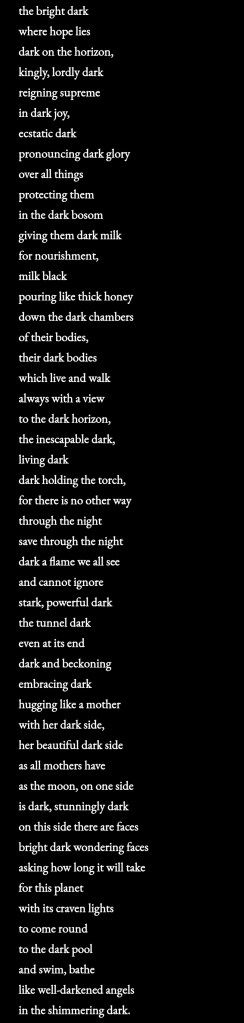
For Paul W., who left too soon but said Goodbye all the time.

We love you, Paul, and see your black pearls shine through the glory of the night.

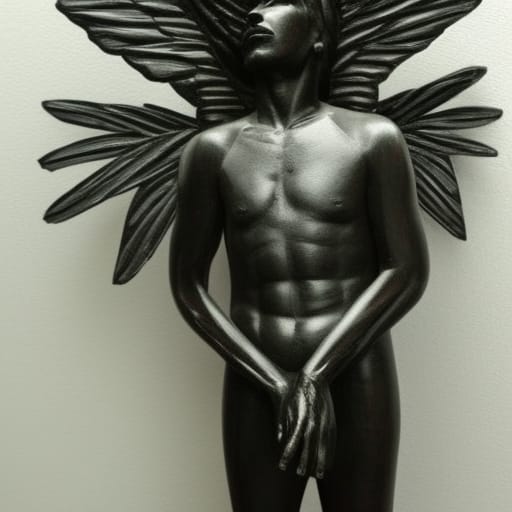
Paul’s birthday song one year. He believed angels, and other holy things, were dark. Black.

Squinting at the suchness of things

Squinting at the suchness of things.  When you look up to the stars and you’re tired, the lights up there are nothing wondrous, nor are they anything particularly bleak.  When you’re tired, the stars do not seem to carry any message, nor do they seem to signify anything.  They are the lights you’re used to considering when the head bobs upwards, because they just happen to be there; there is nothing to them, really, no promises of gods, no absurdity, no lack or gift of clarity.  Just lights; it’s as though our tiredness allows us to see things as they are, without any ulterior motive, even though enlightenment is the last thing on our hearts before we drift to sleep.