A Word about Words X of XIII, or, Until it itself sets the limit

Until it itself sets the limit….  Whatever you want to do with your words, just do not treat them as less than they are: powerful, the power-fullest force, capable of everything, incapable of nothing, the levers, the archimedean pivot points, that move the world, transform the world, destroy or create the world, all worlds and words hitherto and all worlds and words to come, a self-propelling machine, a living machine, the machine of our breath, a terrifying, wondrous, living, breathing machine with limitless power, limitless until it itself sets the limit.

A Word about Words IX of XIII, or, When you tell a joke

When you tell a joke, the words themselves make the difference.  It makes all the difference in the world, the difference of a world, of taste or tastelessness, of a faithfulness to context or faithlessness, to say ass instead of rear in the course of a joke, or butt instead of rear or ass, or behind instead of all the others, or posterior, or gluteus, or a hodgepodge or mixture of them.  With the words the joke changes, its charge, its atmosphere, its effect.  So it is with all words and whatever they participate in, whatever they affect or effect.

A Word about Words VIII of XIII, or, May I have a word with you

May I have a word with you, we ask another when we want to share something with him, usually something pressing or important, some scandal, some trial, some bit of frankness and exposure.  In all honesty, though, the word shall have us, the words we speak shall have us in our speaking when we pull the other aside.  They shall come when they wish, as they wish, sweetly and encouraging or harshly and admonishing as they wish, and our lips and tongues will only flap and kiss along with them, in a faithful sort of mimicry, faithful as the possessed can be to the possessor.  So we should ask, rather: May this word have us, may we be had by the word?  Or, better: A word has come–let it take us!

A Word about Words VII of XIII, or, Where there is smoke

The cigarette dangling from his lips couldn’t have burned fast enough: he was nervous about something, but wouldn’t tell me. Sure enough, he spoke, out of a small opening at the corner of his lips where they were not pursed around the cylinder of the cigarette, emitting the words in rings and threads of smoke, sometimes threads with rings ringing them or rings with cords twisted round them. But his words carried neither courage nor honesty, they were his slipshod shack he built against the winds and threatening waters or dust of some storm outside, the storm that bade him hide with whatever means he could find. Neither courage nor honesty; still, there was courage in what he said, a courage to the point of faith, a faith in the living power of words, even lying words, of their believing, or hoping, with a daring hope, that they could make one like me, one so careful around words, to come to believe them, as much as I believed that there was smoke puffing out from the opening at the corner of his lips while he spoke, as much as I believed, as I would claim to know because I would infer, that where there is smoke there is fire. He had courage enough to believe in his fire and the blunt opacity of his smoke, when really I could see right through it all.

A Word about Words VI of XIII, or, Drunk as we are

In the beginning was the Word, the birth of the Word as well as the birth of all words and all things.  Just as in the end there shall be a Word, a dying word, a close, and the death of all words and all things.  For the most part, it terrifies us to speak these words, drunk with life as we are, drunk as we are with our ramblings….

A Word about Words V of XIII, or, A Certain Impasse

A: Language will take care of itself; there’s no need to  get ruffled up about it.  The decay you mentioned having witnessed in the world as it regards language is only a spell along language’s historical unfolding, which carries the ages of linguistic patterns to their fulfillment.  There’s no need to announce that you have detected the culprit of this increasing bastardization of the manner in which we speak, or to regard yourself, or anyone for that matter, capable of seizing control of language’s course and steering it clear away from its troubles, back into some kind of–respectability, of capability for diverse things, for stone-hard sternness as for pillow-fluff softness.  Say what you will, with all of your desperate wordiness: some things are out of your hands, without your capacity to save whatever foreseeing stutterings you might care to express.  B:  Say what we will…isn’t that just it?  Isn’t there some will in language and therefore some responsibility?  Isn’t there a saying the wrong thing–and a saying the right thing?  Isn’t there a difference here, and an important one?  Whatever you might say, isn’t that the truth of a good, truthful word?  That it commands us, yes, but then we obey, or we fail to obey.  Language seems ever to give us the option of speaking or of silence, or of giving our heritage a hard slap in the face.  A: Whatever you say…but I say differently and see and feel differently too.  You think we would ever obey language’s dictates if we were not forced to obey, if we were not already swimming in its tides, as it were, or trapped in the frustrating dead-ended passageways of its maze?  B: Whatever you say…right–or wrong; who cares?  We may speak from either side and language may laugh in our faces from her throne, from which she decrees that we exemplify our freedom, extending to our freedom to alter her, or decides to have all power invested in her and her alone.  But before we even get off the ground as far as assessing what our tongues could do is concerned, we should consider this: whether we are worthy of our words, or whether our words perhaps make a mockery of us, or are ashamed of us, or disguise themselves as different from responsible sayings, perhaps as distractions, or ruses or–excuses.  A: So you say what you want and I say what I want.  We MUST say something, therefore we say what we want, right?  It seems we might have reached a certain impasse….  B:  Or maybe it is this: we HAVE to want, we have to desire, we have to WILL, and therefore we have to take responsibility, and therefore we have to take responsibility for what we say, we have to will what we say….

A Word about Words IV of XIII, or, Eloquence, what a shame!

Eloquence–what a shame!  The words that really matter, that make people melt or go off to war or commit themselves to some inner vision, they tend to be so common as to be crude or vulgar.  Hammer: how simple, but what it could build!  Child: how ordinary, but its possibilities!  Painter, writer, thespian, friend, enemy: words for banners and billboards, but what they say about a person, about what she might become, what she must become, or be, if this word of hers is held dear by her!  The eloquent man or woman is usually hiding something; perhaps the fact that he really has nothing to hide, no really deep secrets, no real depth at all.

A Word about Words III of XIII, or, Those clumsy words

Those clumsy words that really don’t seem to do anything but ricochet off one another in fits of laughter or tears, or during sex, or when seeing one of Rembrandt’s self-portraits on a live canvas for the first time, or any time, or of drunkenness or empty-headedness–what are they?  Reminders that even god godself, even the holy, becomes sloppy at times.

A Word about Words II of XIII, or, You may say

You may say I love you and I may say I love you and we may agree on our saying the words and our meaning them.  But words come with their unspoken tricks, one of which is pretending to share the unsharable, making the inaccessible accessible, make-believing that, it nhis accessible.  How a word, even a lie, can still make us bow and revere, can still make us follow, can still make us meet the other’s eyes, could still make us love!  Love the other and his lies as you love his eyes, even ask for more of them as you ask to stare into their green some more, eat them up like delicacies and the finest things, share the meal with him and, perhaps, get the other to believe in himself in the mix, believe in his word, take his word more to heart, more seriously.

The Wasp

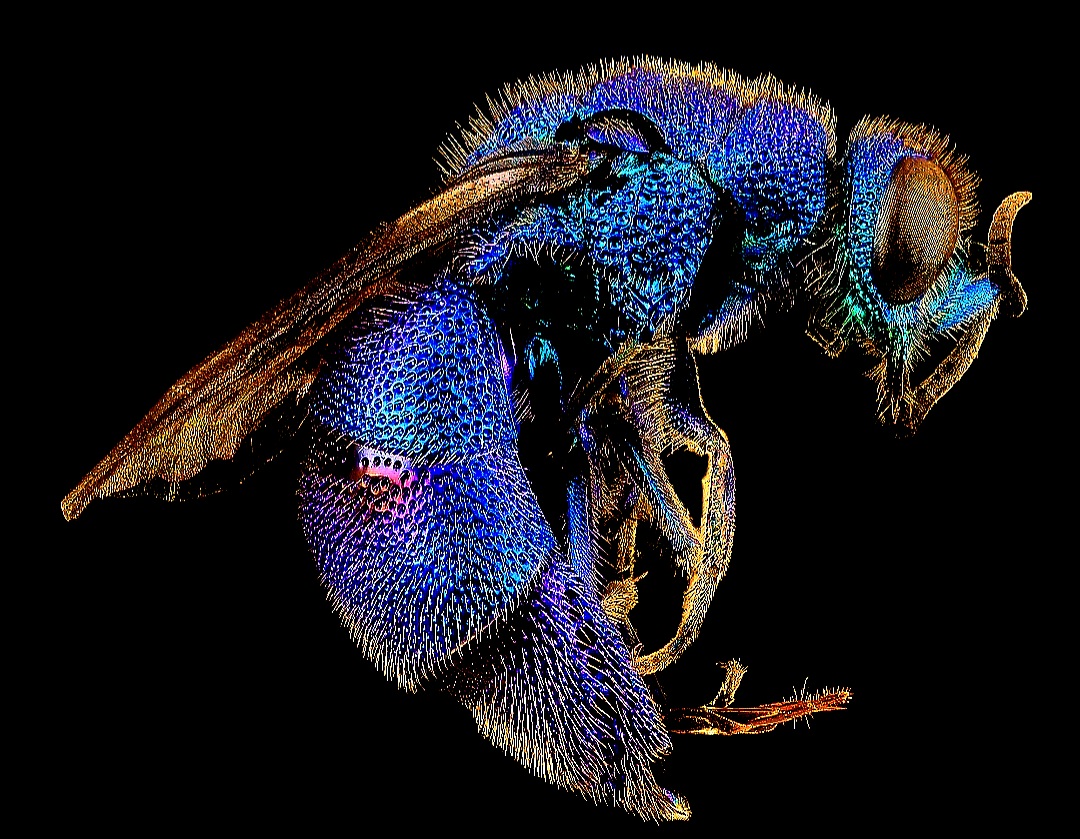
Its crimson and yellow thorax

Throbbing with pain,

Its wings broken

Keeping it down, unable to fly,

Its extraterrestrial-terrestrial head

Turning and inspecting,

Its keenness for color and the taste,

Having color, of color,

Its love affair with the flower,

Making the stamen turn upwards,

Its burning faltering posture,

Burning because the thing that took

Its wings was a bird whose

Pecking was enough, more than enough to rip

Its wings to shreds,

Burning with envy that the dread bird,

Its mortal enemy, was able to fly

Soaring after it was stung, no care in the wide world,

Its not glowering or pouting, but keeping to itself

Buzzing muttering curses no one but I heard,

Its going away into a small hole to die,

Praying only to buzz and be alone,

It had me not follow it but stay behind it

Thinking of its lonely funereal staggering,

Its whispering buzz

Reminding me with its courage,

Its scar and how it handled the scar,

Walking with such glowing pride that final walk,

It had me think of the many impromptu funerals

Being played small on earth’s floor,

It had me think of my own, my death and all,

Wondering if I might leave with such badges,

Its badges of courage, a scar, pride and envy.

The Doll

Like dolls, the characters are lined up

in rows along the roads and shelves

of the world.


Some I want to take from their boxes

and make of them an innocent recreation,

a plaything.


Others—what it is, I cannot say—I leave

as they are, wrapped in some type of

packaging


Locked always in their sheen, their stock is

Becoming a burden to the stores,

stockpiling;


I pass these untouchables to find a doll

that suits this world of fantasy I

created,


one whose button eyes will really look at me

across the table, reflect the light but

take me in.


I roam the rows even as they are barely lit,

I learn of the features of the characters:

they can speak,


each with its peculiar drawl or dialect,

some speaking to please, others

just whining,


still others have a feature that would allow

these creatures to whisper to me

at playtime,


still others have the added virtue

of a voice with which to shout

at heaven.


Pressing a button on the outstretched palm

of each character to hear its voice,

a doll’s voice,


I realize there is nothing to be done

and take one home to share with me

its doll’s life.


This doll across the table has purple eyes,

but eyes nonetheless that stare at me,

speak to me.


I reach across to push her pillowy palms

to get her to speak; her left palm

makes her speak.


She tells me of life in the stores,

being shipped and shelved throughout

the bright earth.


There are places I saw, she says in her

doll’s voice, tinny and mechanical,

they were bright.


On the way to a toystore in Chicago,

while being wheeled up the ramp of its

grand staircase,


I looked across the highway to the river,

the running water and running people,

the babies


Pushed along in strollers by fleshy mothers,

I looked at this and almost cried, but

I can’t cry.


The way the light dressed them, the light

played with them, the light was unpackaged,

brilliant stuff.


Her getting close to poetry in those phrases,

in her doll phrases, programmed,

has me beam.


I ask her about the other dolls, why there

were so many and such various characters

on the shelves.


She must be pressed again, the left hand,

before continuing, voice programmed

for sadness,


There are dolls that no one will touch

because the fabric, the material,

it feels off.


I reach across to touch her and feel

the plushness of her body, its down

and texture.


Her voice begins to sound frail—

I wonder whether I have to change her

batteries.


She goes on, Each doll is different,

you know that; the history of the doll,

the doll’s deeds.


One doll I met in a gift shop off the

Kansas Turnpike, she murdered

her siblings,


She left them lifeless in their rooms—

each one was given a room—spread the cotton

everywhere.


She pouts her singsong voice, blinks the

eyes that cannot cry, looks at me again

then goes on,


If you ever travel to Kansas, exit 93A off

the turnpike, you will see her dark hair,

crystal skin,


her appearance charming, her dress sharp,

but dangling there alone on a hook next

to pliers.


Another doll is in a warehouse for a shop

on the internet; he has the most lively

music box


Which would play a rambling tune for you

if he were not in that dark place, playing

all alone.


Another doll is at the dark bottom of a lake

in Arizona; she fell from a girl’s

swimming hands.


The fish, I was told, every now and then

kiss the algae from her seams,

they clean her.


I ask her why it took so long for her

to be purchased, why she was still

dangling there


She tells me not to worry, then looks me

in my brown with her purple eyes, she

drops a tear,


A tear from her ductless eye, then more.

She hooks my empathy with her

real wet cries.


I lunge across the table to hold her,

to vow never to let go, and

cry with her.
Waterful World

He told everyone the night before

that it would come, but no one

believed him, left the windows

unshuttered, in some cases open,

left books and other unutterably

precious things outside; a woman

left her beloved labrador tied

to a tree beside the house; now

that tree as every other shakes

like a tender, timid tall man,

the land is liquified, free-flowing,

the waters pour without relent,

without distinction over the island,

sending the island back into

the waters below; sky and earth

become one as before the wind

of creation. Already the boats

are being unmoored, freed from

their tenacious grip to the sea’s

bottom and with the whole earth

confuse up and down in constant

testing of their respective limits.


We will never see that blue again,

a fellow tells him as both swim

in the swelling sea, accompanying

each other through the tumble

of landlessness. Don’t worry,

he tells the distraught swimmer,

I have a hope within simmer

that we will adjust, find a way

—if not today then our progeny—

to live in this waterful world.

Don’t hold your breath, the fellow

says, and begins to tread less

and less, begins to sink, his hat

staying behind to toss about

on the water’s spraying face to

recall for the habitants of earth

a former civilization, a time

when men wore hats in the rain.

The other does not complain, but

remains the same head bobbing

in the waters’ churning, channeling

a diver’s breath to sustain him.


With a mighty mercy the sun

casts light intensely on the deep.

The man who swims, hopeful,

through what was his home suns

himself lying belly-up. Somehow

I knew, he told himself, despite

the forecast of clear skies,

that it would rain, that the floods

would do in those who cannot swim

for good. That this is a different,

less hospitable world, he mused

to himself as the waters caressed

his cheeks, held with its cold hands

his serene body. This sun’s blaze,

although it brings warmth he said

and shut his eyes to let it shine

on his closed lids, cannot burn up

this wet, no. And if somehow,

ages from now, the sun glows

the water up, up into the sky,

surely, sure as land once was,

it will fall back, rain back on us.

With the Demon Again

Which one? Which one,

he pressed, Which one

would you choose, which

encapsulates the yes

you cried in jubilation?


I tried, I tried the test

he gave, it made me ask

which would I save, which

of the numberless moments

would I preserve, favor?


This monster’s speeches,

always heavy speeches,

his viciously roundabout,

imponderable speeches,

gave me a grim pause.


I thought of master Woe

and glory-adorned Joy,

the showers of my life

that brought me to cry

or laugh or dance, sing.


All of life’s hard edges,

its spikes and daggers;

with care I considered

the host of life’s dangers,

life’s once-only thrills.


I nodded to the demon,

I understand you now,

how these entry points

to eternity, the moments

you spoke of so eerily,


They are all the same,

crushed, whether we will

or not, by the circle.

I will not try to answer;

it would malign the moment


which, once or recurrent

...

is indifferently perfect.

They’re probably black as tar

They’re probably black as tar,

Or brown now, an autumn brown

With a lump the size of a fist

Or a few the size of grapes

Either way I don’t want to see them,

Let them stay where they are,

Inside me and surprise me

At the finale when I lose breath,

When I can’t catch up, it tapers off,

I fall to the floor and gasp and gurgle,

Someone finds me but it is too late,

I’m gone now, just know

That the lungs always wanted a good laugh.