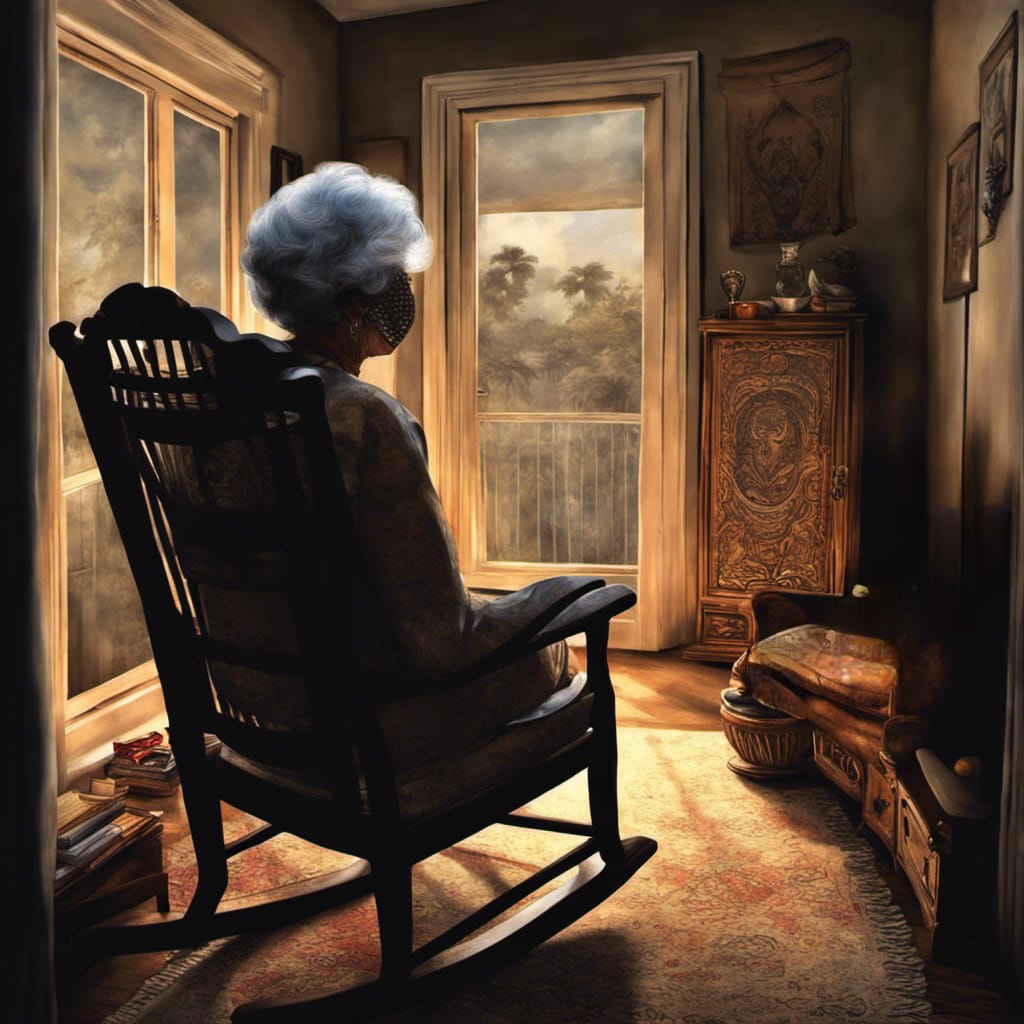
While we’re all here, the matriarch of the family said, leaning over the dinner table of emptied plates with the slim weight of her body, taking in, with her eyes, the entire group of us in one glance of them, I have something to tell you. We thought that she was going to give us the old news about her dying, but she said instead: I didn’t make this dinner. In fact, I have never made any dinner for you. You come to me hungry and with your days’ problems, but all along–she laughed, and spittled a bit when she laughed–I have been an imposter. There is the rocking chair, watching the news–always full to choking with calamity and, not states of the nation, but pressing questions of the nation, questions that rack you–when you would come in and disturb me from my half-awake revelry, it wasn’t Ma or Grandma you found, but just a tired old lady, tired and dressed in her painting gown with specks and splotches of paint up and down the garment, some of it spreading to the cushion of the chair, tired and confused as to what role she is to play now that her last days–there went the mention of the end, ever-present on her lips at this point, some of us even sighed with relief at the words–are close upon me, I can feel the breath of–what? We all wanted to fill in the word for her, but, in an about-face that astonished all of us present, she went on: Not what you all are thinking, I will not waste my breath on that word, I know you’re all running thin of patience hearing me utter it, you feel my house has been more than a trifle cold as of late–you’re right, I have been running it cold, and feel most at home in the cold–some of you don’t even bother to visit me any longer, she sighed like a retired performer, and I’m confused to find you here now for this family dinner. This family dinner, she repeated, and the words rang empty like unlearned lines, or lines learned so much by heart that the heart has at last become jaded with the words. I feel the breath of–and she stopped again, this time as though toying with us, goading us into guessing what her riddle might be. But she stopped before any of us there could get a word in edgewise: The breath of indistinction, she said, and said something that finally allowed us to learn more than the pantomime of this lady named Jayne. Whenever you call out to me again, telling me Ma, I need your advice or Gramma, I need money to get home, ask yourselves whether you ever knew me. Yes, we were all perplexed, but at the same time we were guilty as charged; we stared at one another and at the stranger at the head of the table, befuddled and off-kilter. Some of us were so uneasy in the woman’s presence that they made to leave, when she stopped them with her palm pressed lightly on the wood of Grandpa’s, the man we called Grandpa, table, the table he himself had crafted for the family in Germany and had shipped here to the States in the 1950s when he found his family here instead, she stopped them from making any more than a fidget upwards and announced: Now, I know that you are not yet sated, so I have another surprise for you. She must have seen the frozen fear and the complexion of uncertainty smeared on all our faces. Dorothy, she pointed to the eldest of the grandchildren from her eldest daughter, the woman she called daughter. Dorothy, she called out to the young college-aged woman she had grown used to calling grandbaby and grandchild, little girl and grandmotherly things like that, go on to the kitchen and fetch the cake I made this morning. It’s a new recipe, she eyed us all and got into character, I hope you like it. We’ll have dessert, she said, and we would, in the silence and the low murmurings sometimes verging on laughter, sometimes verging on tears, of a family who had finally made it home, all together.

 Love the Dust